
 China
China
China is all about numbers. 8,000 life-sized Terracotta Warriors. More than 13,000 miles of the Great Wall of China. 21 million people in the country’s massive capital, Beijing – a truly 21st century city. A nation with 5,000 years of history still tops lists as one of the most attractive travel destinations in the world. From the rice paddies-turned-modern metropolises, Hong Kong’s neon skyline, and Macau’s glitzy Las Vegas vibe to the holy temples of Beijing and beyond, China holds surprises at every turn. Across this vast country ancient traditions and superstitions blur together with today’s business, travel, and cultural establishments. And these closely held traditions shine when you leave the city and venture into vast, rural China where remote villages and ancient temples are scattered throughout the country’s 3.7 million square miles.
Highlights
- Beijing
With a population of over 21 million people, China’s capital city of Beijing is a force to be reckoned with. Beijing is located at the northern tip of the triangular-like North China Plain and is surrounded by mountains from the north, northwest, and west, which shield the city quite well. Becoming more urbanized each day, Beijing is modernizing while still maintaining its ancient, old-world charms. That’s what’s so exciting about this incredible city- new technologies and structures can be seen at one moment, and at the very next you can see an ancient temple, wander the narrow hutangs (alleys), and chow down on traditional Mongolian lamb and Sichuan-style crayfish!
- Great Wall of China
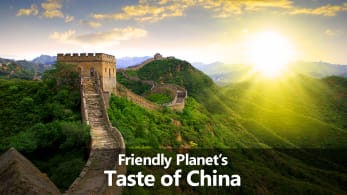
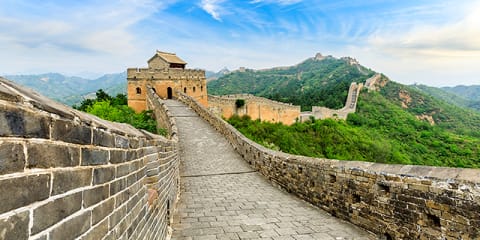
The Great Wall of China is as impressive as it is long, spanning over 13,000 miles across northern China. The wall stretches east from the eastern coast to the deserts of western China. Before the Ming Dynasty when bricks were used to add to the wall, rammed earth, stones, and wood created its foundations. The wall was extensively rebuilt and fortified during the Ming Dynasty, and its original purpose was to protect China’s northern borders from various nomadic groups of the Eurasian Steppe. Several walls were built as early as the 7th century B.C.E., and eventually these fragments were joined together to create the more unified structure we recognize today as the Great Wall of China.
- Xi’an & the Terracotta Army
The Terracotta Army in Xi’an consists of thousands of clay sculptures depicting the armies of Qin Shi Huang, the first emperor of China. These sculptures exemplify a form of “funerary art,” representing the life of the late emperor. They were buried with the emperor in order to protect his spirit in the afterlife. Dating to the late 3rd century B.C.E., the figures were discovered by local farmers in Lintong District in 1974. Each soldier sculpture may be a part of a different rank in the army, resulting in various sized likenesses. The tallest are the generals, and other possible ranks are warriors, chariots, and horses.
- Shanghai
Steeped in a curious history full of gangsters and colonial adventurers, Shanghai has blossomed into an incredible hot spot that is a must-see for travelers to China. As one of the most populous cities in the world, it stands at a striking 24 million in population—and is on the rise. Glass-and-steel high-rises have created a stunning skyline among the clouds as down below, commerce and culture flourish. Don’t miss a chance to check out the city’s budding arts scene, including music and Chinese Opera, as well as traditional Chinese cuisine.
- Yangtze River
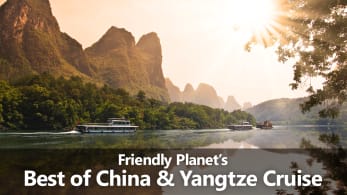
The Yangtze River is not only the longest river in Asia, it is the third largest in the world, behind the Amazon and Nile, respectively. For 3,915 miles, it wanders throughout China’s borders – creating a scenic water way and contributing immensely to China’s economic boom. In fact, the Yangtze River Delta accounts for roughly 20% of China’s GDP. The Three Gorges Dam which crosses the river near Sandouping in the Hubei province is the largest power station (hydroelectric) in terms of installed capacity. Those who have the pleasure of cruising the Yangtze River will be treated to incredible views of The Three Gorges (Qutang, Wu and Xiling) which lie between Chongqing and Yueyang and features cliffs that soar thousands of feet above the river.
- Forbidden City
The Forbidden City served as the Imperial Palace of China for almost 500 years, spanning from the beginning of the Ming Dynasty (1368–1644) until the end of the Qing Dynasty (1644 – 1911). As the political center and stronghold of China, many emperors and their families lived within its fortified walls. It is the largest collection of preserved ancient wooden structures in the world and is now home to the Palace Museum. The Forbidden City is a rectangular edifice that is located in the center of current day Beijing. The design of the Forbidden City reflects a significant amount of symbolism. For example, yellow symbolizes the imperial power of the emperor, so all of the roofs are glazed yellow.
- Tiananmen Square
Beijing’s city square, better known as Tiananmen Square, is one of the city’s most iconic sights. Tiananmen translates to “Gates of the Heavenly Peace” and is named for a monument placed there to mark the entrance into the Imperial City (where the Forbidden City was located). In 1989, the Tiananmen Square protests and subsequent military crackdown marked a significant and sensitive moment in modern Chinese history. This remains one of the most politically-heated topics in China, just as Tiananmen Square remains one of the most visited places by travelers to the city.
- Chengdu
Known as the capital of Sichuan Province, Chengdu is famous for its relaxed pace of life, bold cuisine, and beloved giant pandas. With a metropolitan population of over 20 million, the city has been a cultural hub of southwest China for more than 2,000 years. Visitors can observe giant pandas in protected conservation centers that support breeding and preservation efforts. Chengdu is also celebrated for its Sichuan cuisine, known for its use of chili peppers and Sichuan peppercorns, as well as its traditional teahouse culture where locals gather to relax and socialize.
 With a population of over 21 million people, China’s capital city of Beijing is a force to be reckoned with. Beijing is located at the northern tip of the triangular-like North China Plain and is surrounded by mountains from the north, northwest, and west, which shield the city quite well. Becoming more urbanized each day, Beijing is modernizing while still maintaining its ancient, old-world charms. That’s what’s so exciting about this incredible city- new technologies and structures can be seen at one moment, and at the very next you can see an ancient temple, wander the narrow hutangs (alleys), and chow down on traditional Mongolian lamb and Sichuan-style crayfish!
 The Great Wall of China is as impressive as it is long, spanning over 13,000 miles across northern China. The wall stretches east from the eastern coast to the deserts of western China. Before the Ming Dynasty when bricks were used to add to the wall, rammed earth, stones, and wood created its foundations. The wall was extensively rebuilt and fortified during the Ming Dynasty, and its original purpose was to protect China’s northern borders from various nomadic groups of the Eurasian Steppe. Several walls were built as early as the 7th century B.C.E., and eventually these fragments were joined together to create the more unified structure we recognize today as the Great Wall of China.
 The Terracotta Army in Xi’an consists of thousands of clay sculptures depicting the armies of Qin Shi Huang, the first emperor of China. These sculptures exemplify a form of “funerary art,” representing the life of the late emperor. They were buried with the emperor in order to protect his spirit in the afterlife. Dating to the late 3rd century B.C.E., the figures were discovered by local farmers in Lintong District in 1974. Each soldier sculpture may be a part of a different rank in the army, resulting in various sized likenesses. The tallest are the generals, and other possible ranks are warriors, chariots, and horses.
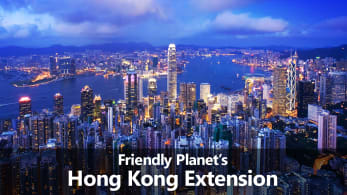
 Steeped in a curious history full of gangsters and colonial adventurers, Shanghai has blossomed into an incredible hot spot that is a must-see for travelers to China. As one of the most populous cities in the world, it stands at a striking 24 million in population—and is on the rise. Glass-and-steel high-rises have created a stunning skyline among the clouds as down below, commerce and culture flourish. Don’t miss a chance to check out the city’s budding arts scene, including music and Chinese Opera, as well as traditional Chinese cuisine.
 The Yangtze River is not only the longest river in Asia, it is the third largest in the world, behind the Amazon and Nile, respectively. For 3,915 miles, it wanders throughout China’s borders – creating a scenic water way and contributing immensely to China’s economic boom. In fact, the Yangtze River Delta accounts for roughly 20% of China’s GDP. The Three Gorges Dam which crosses the river near Sandouping in the Hubei province is the largest power station (hydroelectric) in terms of installed capacity. Those who have the pleasure of cruising the Yangtze River will be treated to incredible views of The Three Gorges (Qutang, Wu and Xiling) which lie between Chongqing and Yueyang and features cliffs that soar thousands of feet above the river.
 The Forbidden City served as the Imperial Palace of China for almost 500 years, spanning from the beginning of the Ming Dynasty (1368–1644) until the end of the Qing Dynasty (1644 – 1911). As the political center and stronghold of China, many emperors and their families lived within its fortified walls. It is the largest collection of preserved ancient wooden structures in the world and is now home to the Palace Museum. The Forbidden City is a rectangular edifice that is located in the center of current day Beijing. The design of the Forbidden City reflects a significant amount of symbolism. For example, yellow symbolizes the imperial power of the emperor, so all of the roofs are glazed yellow.
 Beijing’s city square, better known as Tiananmen Square, is one of the city’s most iconic sights. Tiananmen translates to “Gates of the Heavenly Peace” and is named for a monument placed there to mark the entrance into the Imperial City (where the Forbidden City was located). In 1989, the Tiananmen Square protests and subsequent military crackdown marked a significant and sensitive moment in modern Chinese history. This remains one of the most politically-heated topics in China, just as Tiananmen Square remains one of the most visited places by travelers to the city.
 Known as the capital of Sichuan Province, Chengdu is famous for its relaxed pace of life, bold cuisine, and beloved giant pandas. With a metropolitan population of over 20 million, the city has been a cultural hub of southwest China for more than 2,000 years. Visitors can observe giant pandas in protected conservation centers that support breeding and preservation efforts. Chengdu is also celebrated for its Sichuan cuisine, known for its use of chili peppers and Sichuan peppercorns, as well as its traditional teahouse culture where locals gather to relax and socialize.
Fast Facts
Already booked on one of our packages to China? See everything you need to know before you go.
| Overview | Capital: Beijing |
| Entry requirements | Please see our Entry Requirements page. |
| Staying Healthy | According to the Center for Disease Control, there are no requirements for travel to China, but immunization against polio, tetanus, typhoid and hepatitis are recommended. Also ask your doctor about malaria suppressants if you will be visiting Hainan Island and areas close to the Laotian and Myanmar borders. Be sure to take insect repellent! A note on blood and transfusions: RH negative and type O bloods are not commonly stored in China. There have also been problems with HIV contaminated blood supplies. |
| Weather | China’s climate varies considerably by region and season, ranging from temperate conditions in the north to subtropical weather in the south. Spring and fall generally offer mild temperatures and are popular times to visit, while summers can be hot and winters cold, particularly in northern China. |
| What to wear | Comfortable, weather-appropriate clothing and walking shoes are recommended for sightseeing. Layering is advised, as temperatures can vary by season and region. Sun protection is useful year-round, and modest attire is appreciated when visiting temples and cultural sites. A compact umbrella or lightweight rain jacket may also be useful during periods of rain. |
| Tipping | Tipping is not traditionally expected in China, though gratuities for local guides and drivers on organized tours are often appreciated. Your tour director will provide guidance on customary tipping practices during your trip. |
| Money & Credit Cards | The local currency is the Chinese yuan (RMB). While Visa and MasterCard are accepted at many hotels and larger businesses, China is increasingly cashless, with mobile payment platforms such as Alipay and WeChat Pay widely used. Travelers should carry some local currency for smaller purchases and consider setting up a mobile payment app before departure. ATMs are available in major cities, though not all accept foreign cards. Be sure to notify your bank prior to travel. Always notify your bank prior to departure to avoid any problems using your credit or debit card while traveling. |
| Shopping | China offers an incredible variety of shopping experiences, from bustling markets and traditional handicrafts to luxury malls and modern boutiques. Popular souvenirs include tea, silk, jade, calligraphy, and ceramics. Prices can vary widely, so comparison shopping is recommended. While mobile payments are common throughout China, carrying some cash is advisable for smaller vendors and markets. |
| Electricity & Power Adapters | 220 volts. Plugs A, I & G. You will need a voltage converter and plug adapter in order to use U.S. appliances. We recommend getting a universal adapter and converter kit before your tour to China. Learn more about electrical standards around the world. |
| Cell Phones & Internet | Cell coverage is generally excellent in cities and along major travel routes. Travelers should check international roaming rates with their provider or plan to purchase a local SIM card upon arrival in China. Please note that certain websites and social media platforms commonly used outside China, including Google, Facebook, Instagram, WhatsApp, and X (formerly Twitter), may be restricted in mainland China. Want to take your cell phone, tablet or laptop, but not sure how to get cell service or wifi? Read up on using your cell phone abroad and the top 5 ways to get Internet abroad. |
| Photography | Cameras and video recorders are permitted, and photography is generally permitted everywhere except at airports and military installations. Memory cards for digital cameras will be available in major cities. |
| Did you know? |
|
Videos
Tours & Packages
- Destinations: China
- including closed packages
Trip Reviews & Photos
We love hearing your stories and seeing your photos! Check out our entire fan photo gallery and upload your photos.